You've been asking an AI agent about your body. It has never seen any of your numbers.
Recomposition across a web planner, your iPhone and your Apple Watch. And an intelligence layer that reads the whole record: weight, food, expenditure, training, bloodwork.
You still decide. You just stop guessing. The engine does the math — training prescriptions with their reasoning, energy balance with the full expenditure model, travel logic, plate math on your wrist. And when you ask a question, the answer is built on your record — not on men in general.
Email, password, card. $9.99/month, billed by Stripe — cancel any time. iOS access via TestFlight during the beta.
Real screens, real numbers — the founder's own dataset.
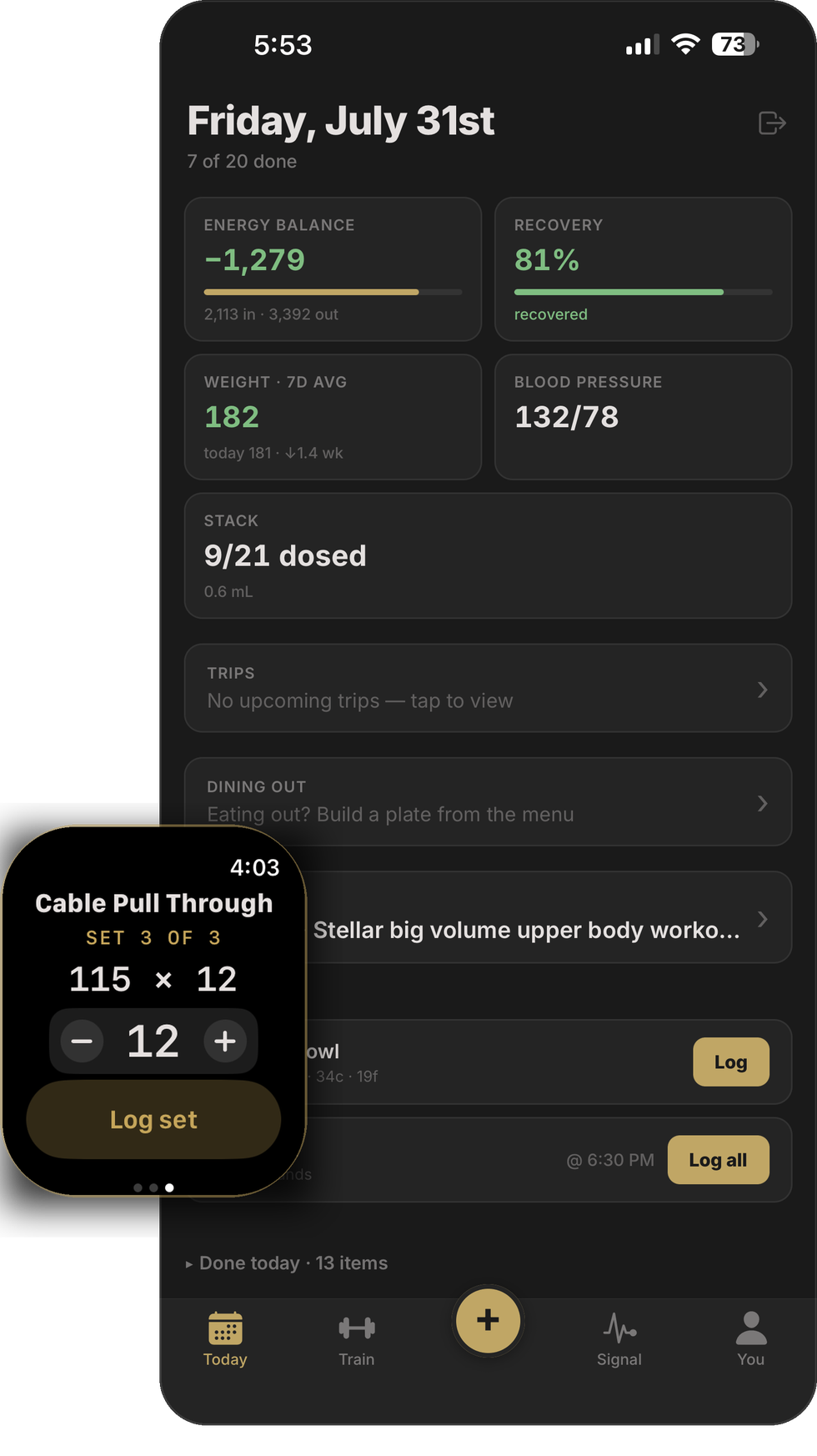
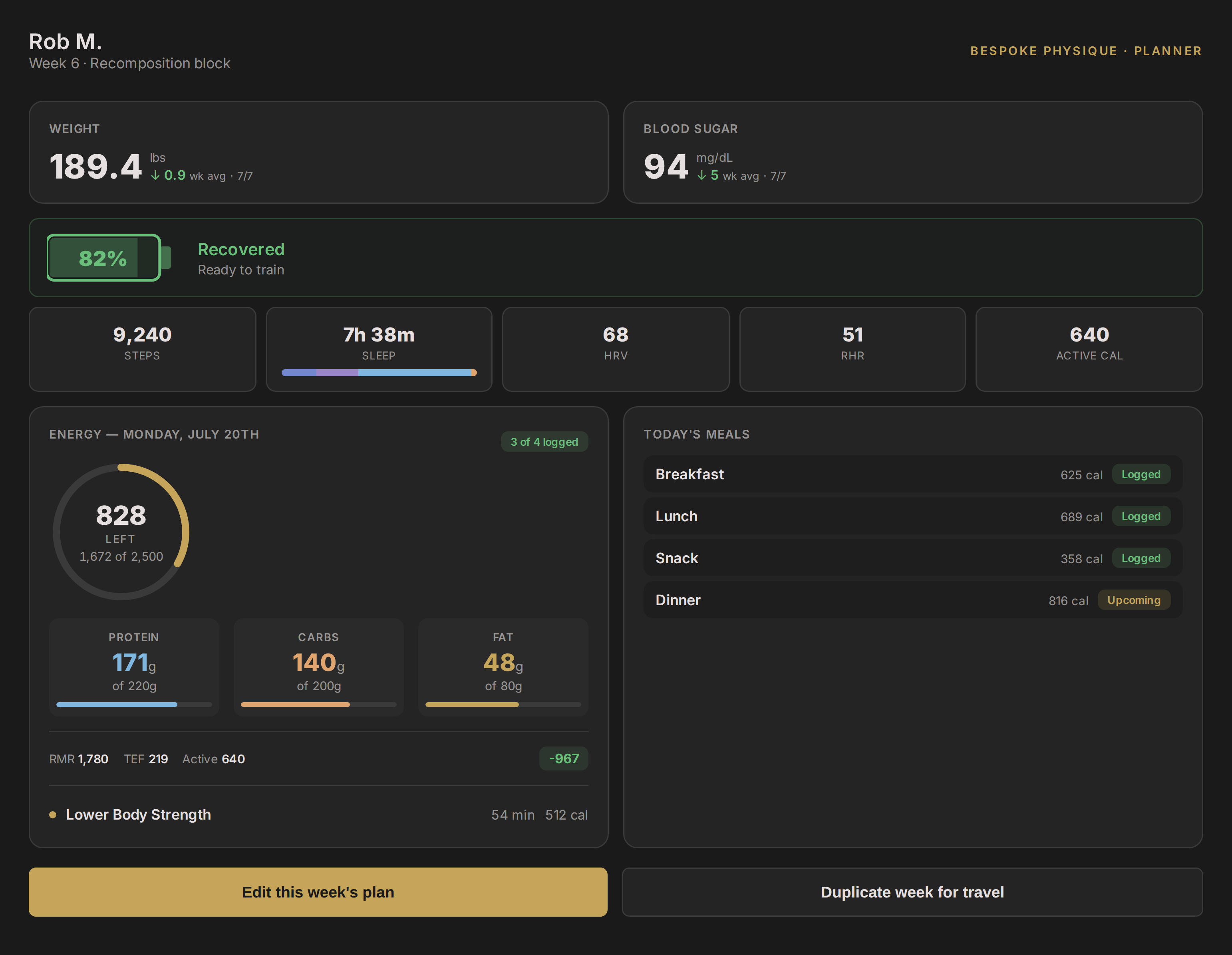
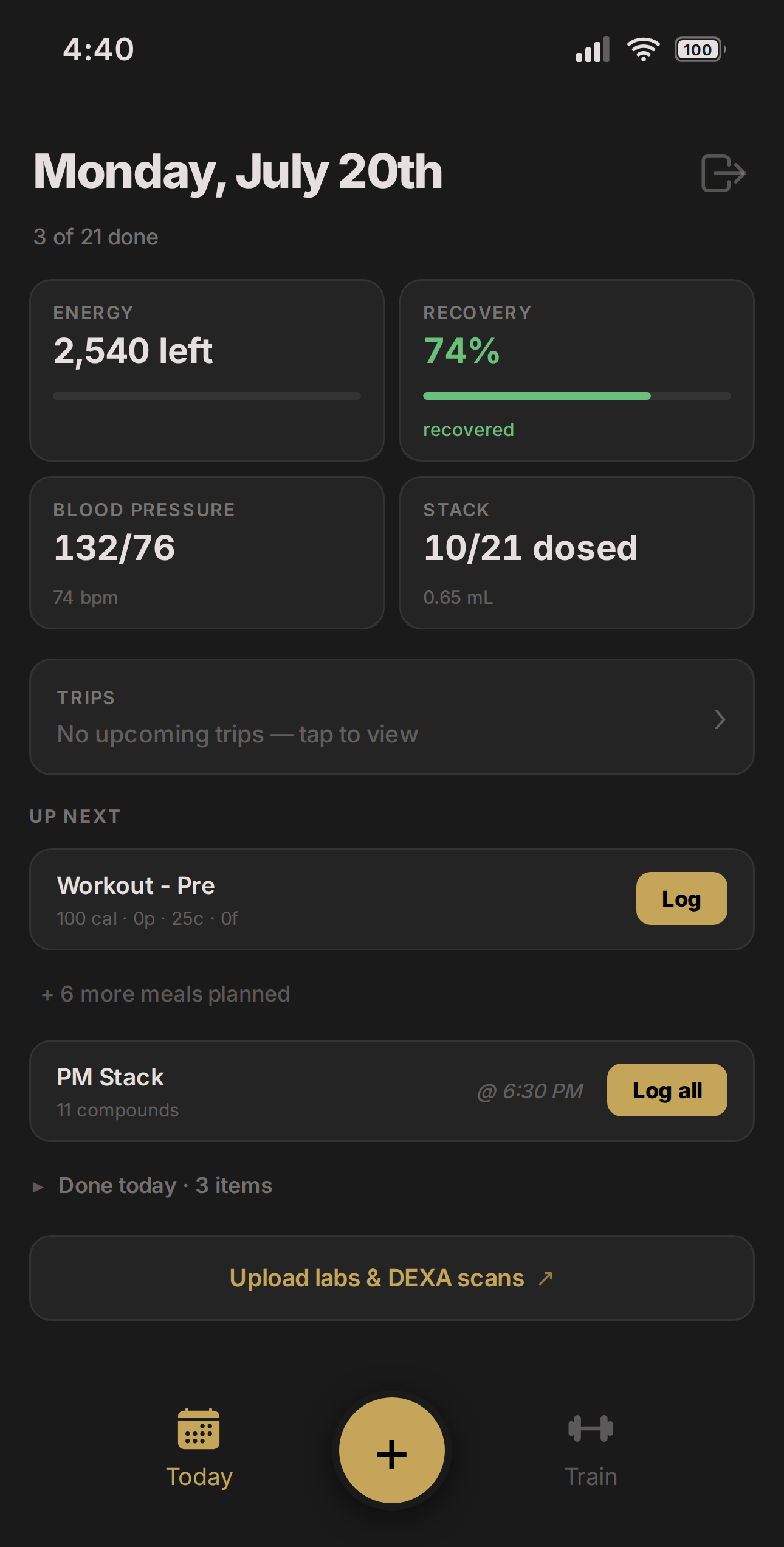
Three moments, and a phone is the wrong tool for two of them. A week of meals is desk work — a wide screen, a keyboard, twenty minutes on a Sunday. What actually arrived at dinner is phone work, logged at the table. And the working weight with the plates per side belongs on your wrist, not on a phone you pick up between every set. Same engine underneath; what changes is which surface is in your hand. The screens below are real, from the founder's own dataset.
Author your weeks: meal plans with real per-serving macros, a full training-block builder, trips, and trends. Drop in a DEXA report or blood panel and it becomes structured, trended markers. One button duplicates a week for travel.
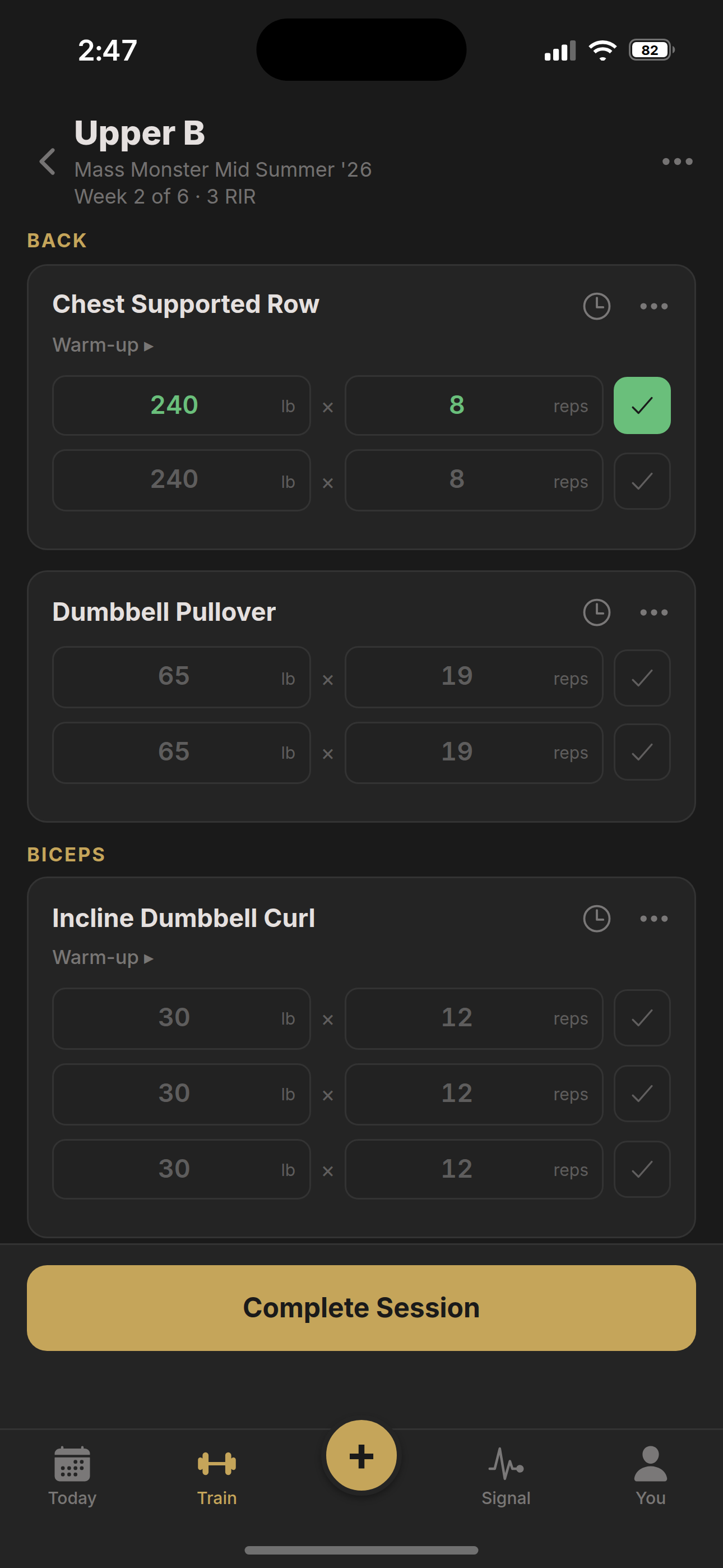
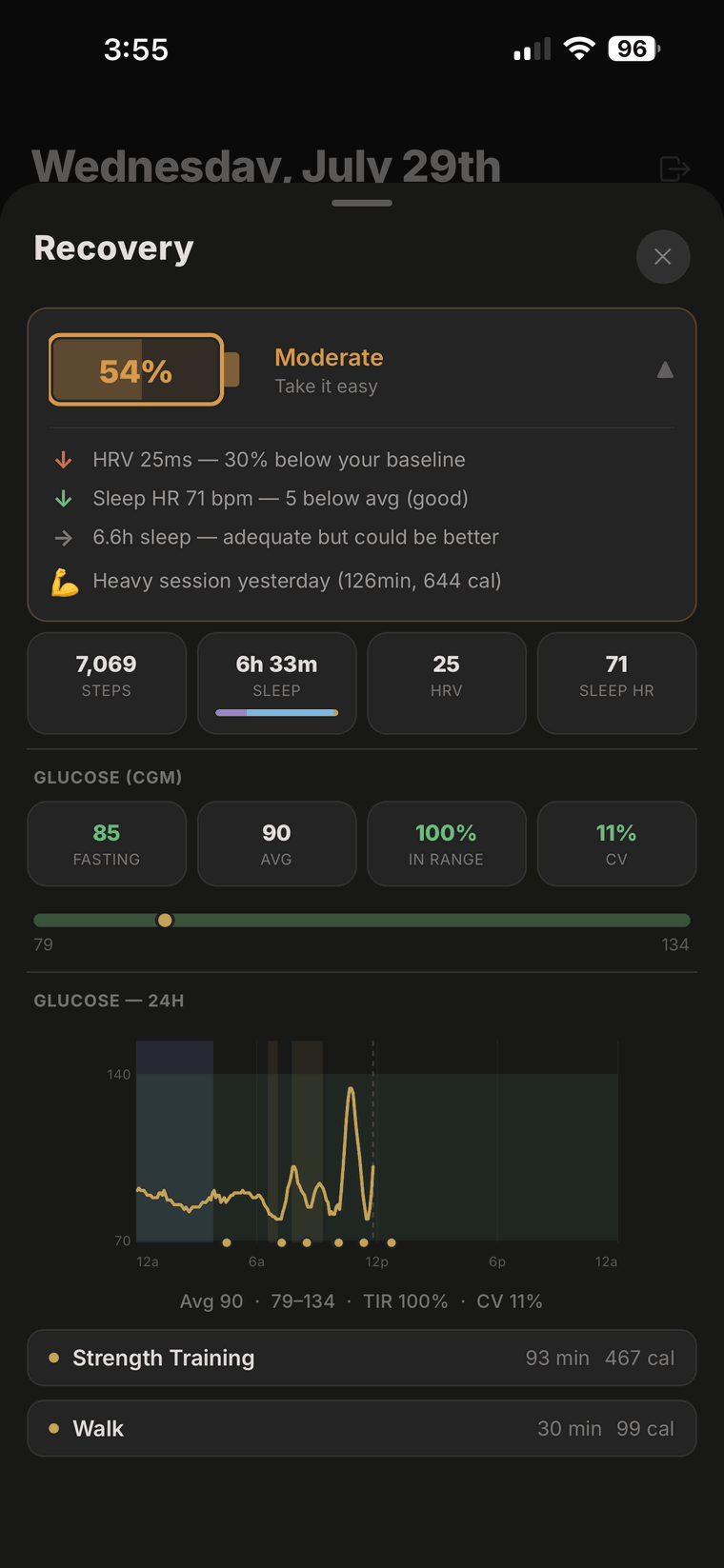
Execute the day. An "Up Next" queue surfaces what's due in priority order. Log food by barcode, search, or a photo of the plate — Macro Vision answers the restaurant meal you could never log. In the gym, every set arrives pre-filled with the engine's target. And the recovery number shows its work — HRV against your baseline, sleep, yesterday's load — so "take it easy" arrives with its reasoning attached.
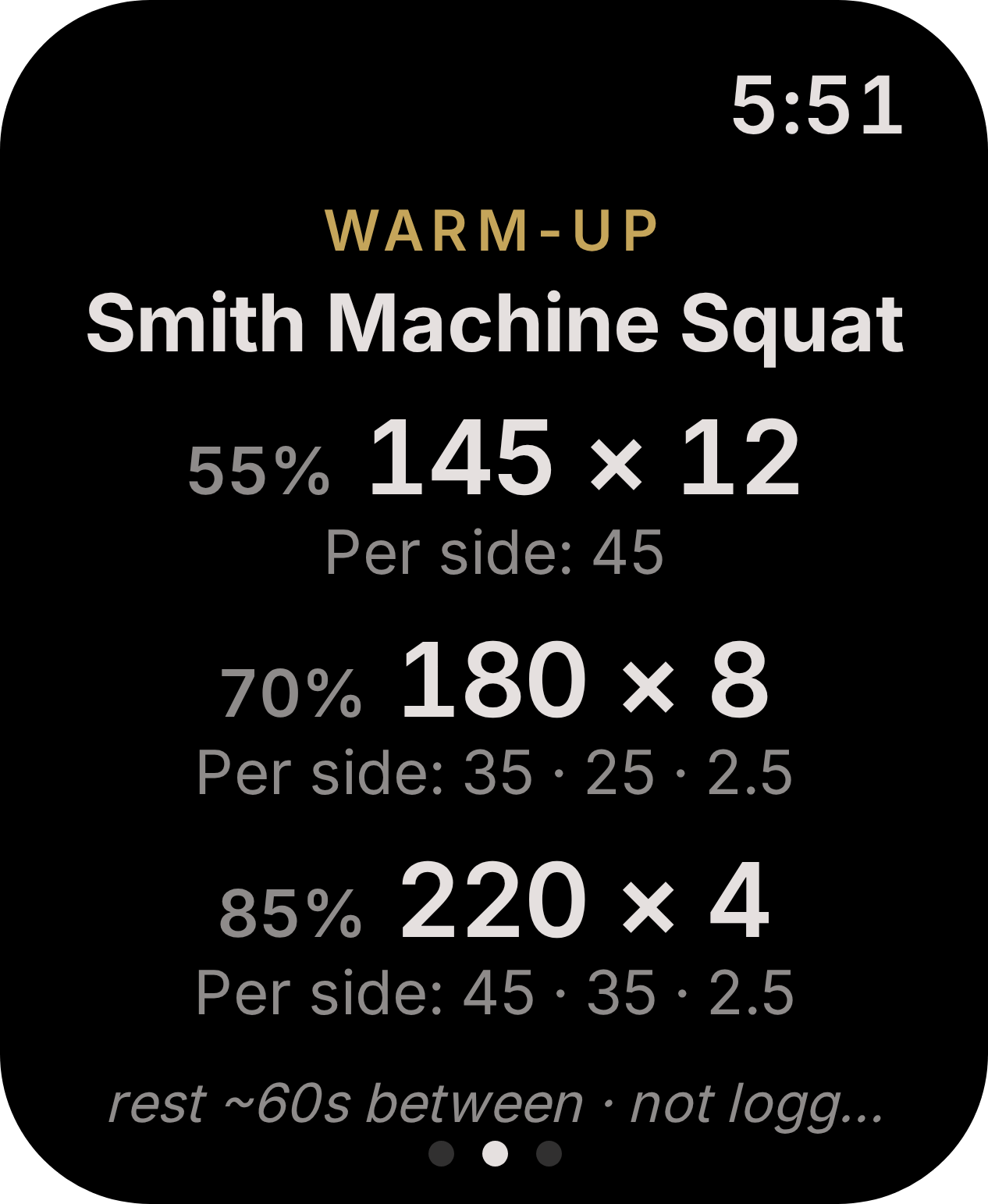
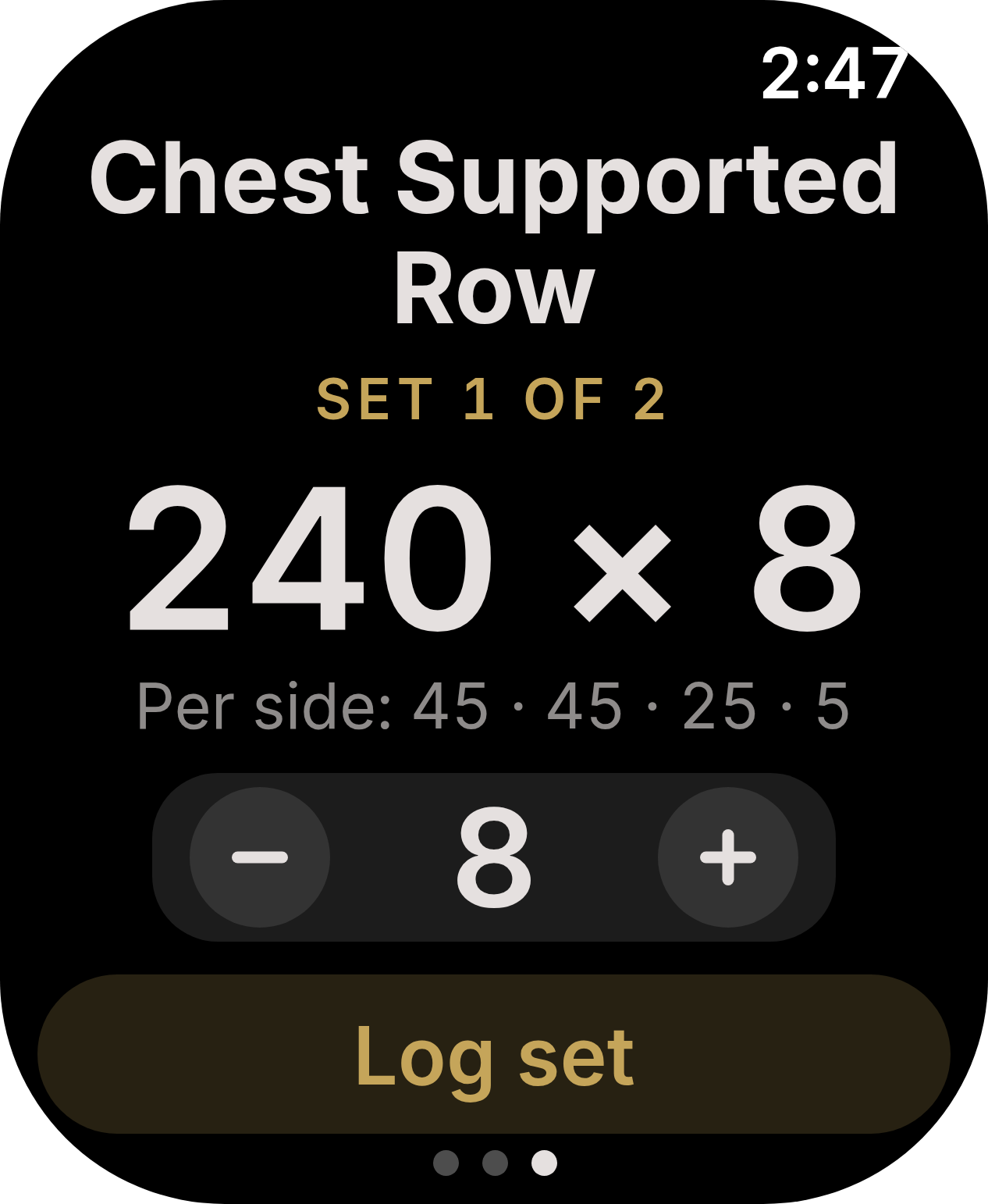
Start a session on the phone and the watch opens itself. Warm-up ladder, then the working set — target weight × reps and the exact plates per side. Log with the Digital Crown.
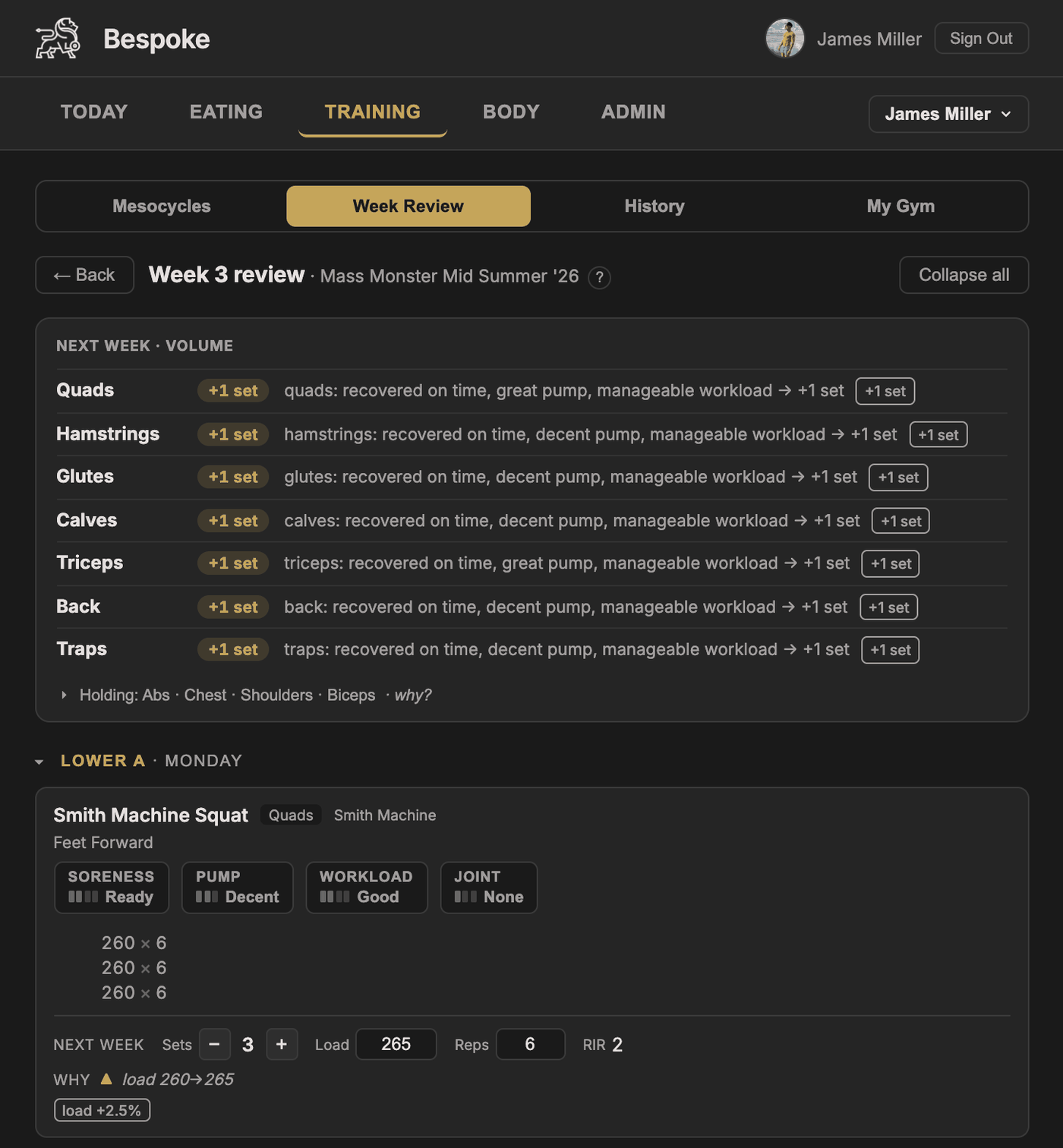
Most apps are a logbook: you decide what to lift, they remember it. This one decides. You lay out a block once, and from the second week the engine reads every set you logged and how the work felt, then writes the next week itself — per muscle, with its reasoning shown. Every number it proposes is editable, and changing one makes it an instruction the engine then respects.
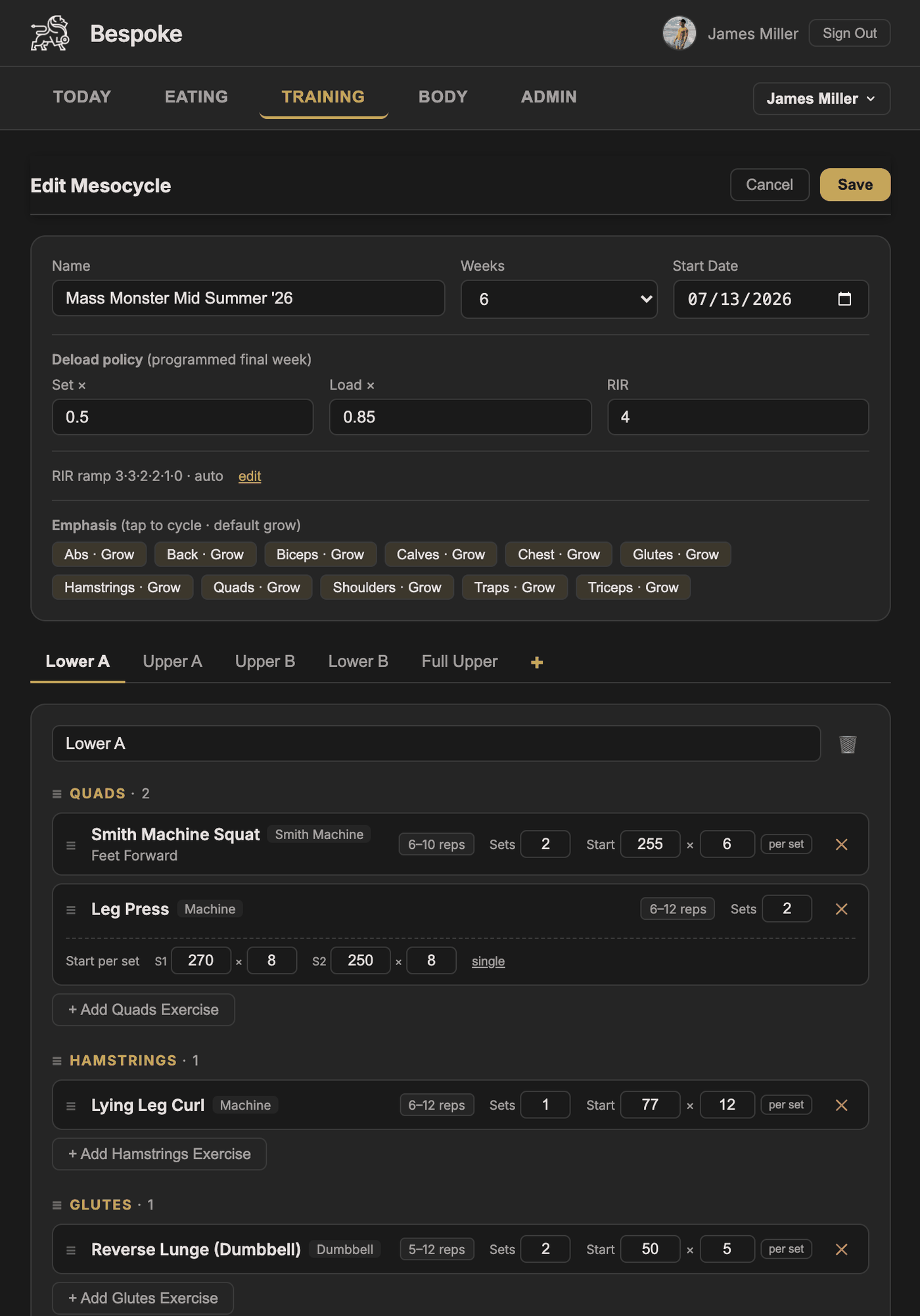
Days, exercises, sets and starting loads — laid out in one sitting and then left alone. Set how hard each muscle is being pushed and the engine holds to it. Weeks here are rounds through your split rather than calendar weeks, so a week that takes ten days costs you nothing and nothing is marked missed.
After each session you rate soreness, pump, workload and joints. That, with every set you logged, produces next week — muscle by muscle, each change carrying the sentence that caused it: recovered on time, great pump, manageable workload → +1 set. Loads move on the same evidence, and the rule that moved them is named. Muscles that should hold are listed as holding, with their reasoning one click away.
Before the working sets, the ladder: what to warm up with, and the plates to put on each side. Never logged against you. The loads are computed for the equipment you actually have — a bar that weighs 55lb, a sled that weighs 80, dumbbells that stop at 45 — so the number you read is the number to load.
The final week of a block runs at the sets, load and effort you set for it, rather than whenever you remember to back off. The rep-effort ramp across the block is declared up front too, so the difficulty curve is a decision rather than a mood.
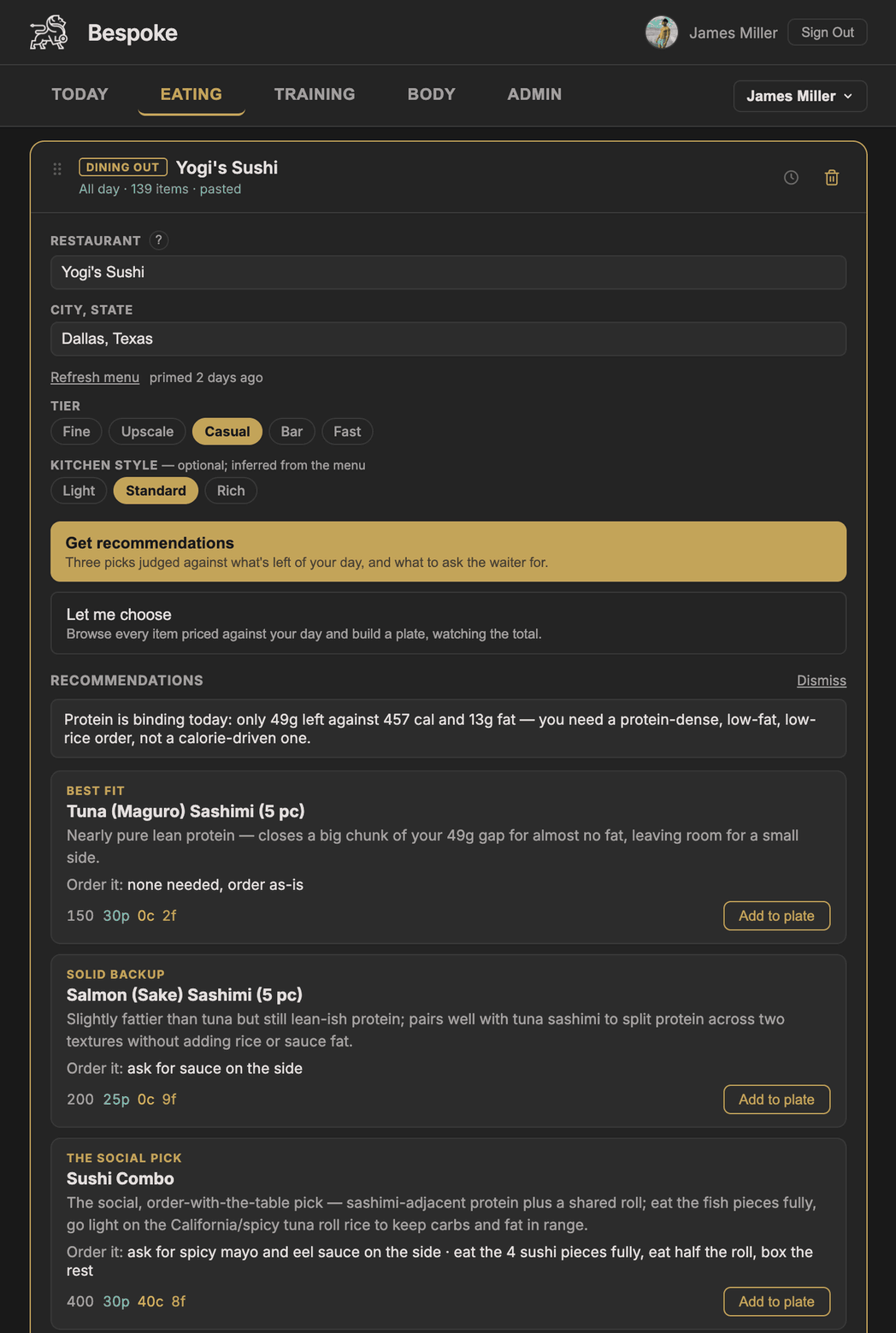
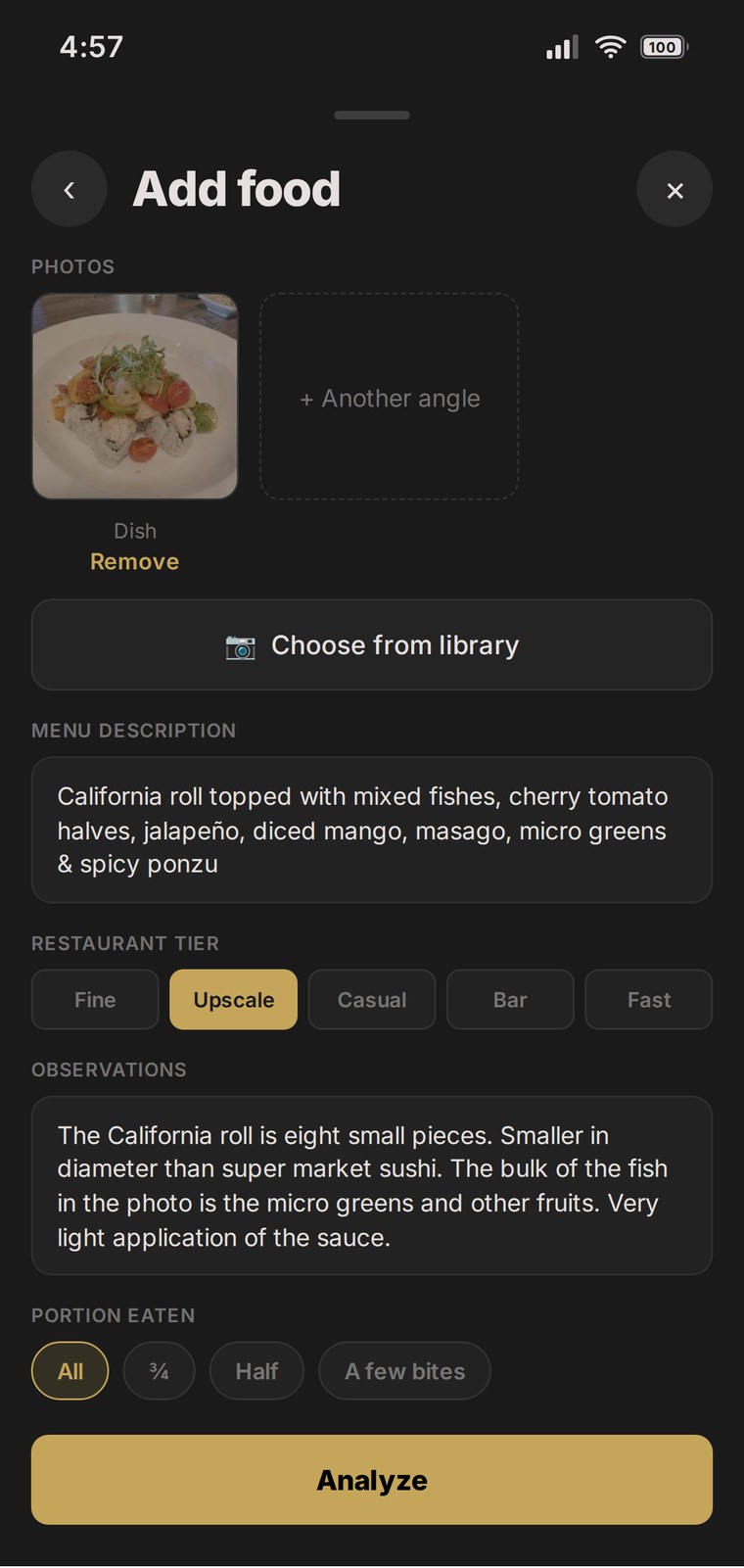
Every tracking app fails at the same place: dinner out. You guess, or you skip it, and the week's data has a hole in the middle of it. Here the restaurant meal is handled twice — once before you go, from the menu, and once at the table, from the plate that actually arrived. The second analysis sharpens the first.
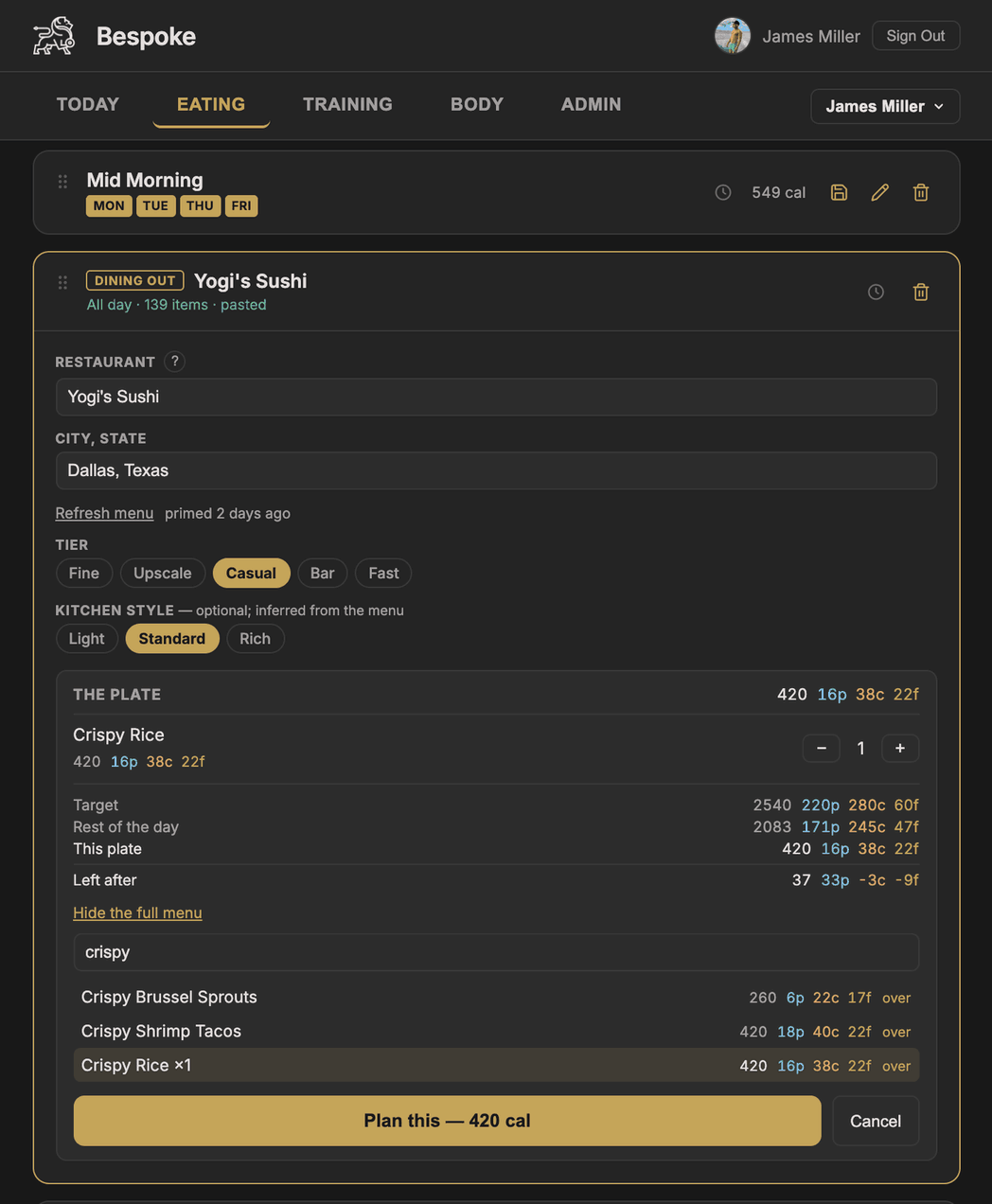
Before you go — the menu becomes a plan
Take a recommendation. Dishes from that restaurant's own menu, with macros on every item, ranked against what is actually left in your day — not a generic list of healthy choices.
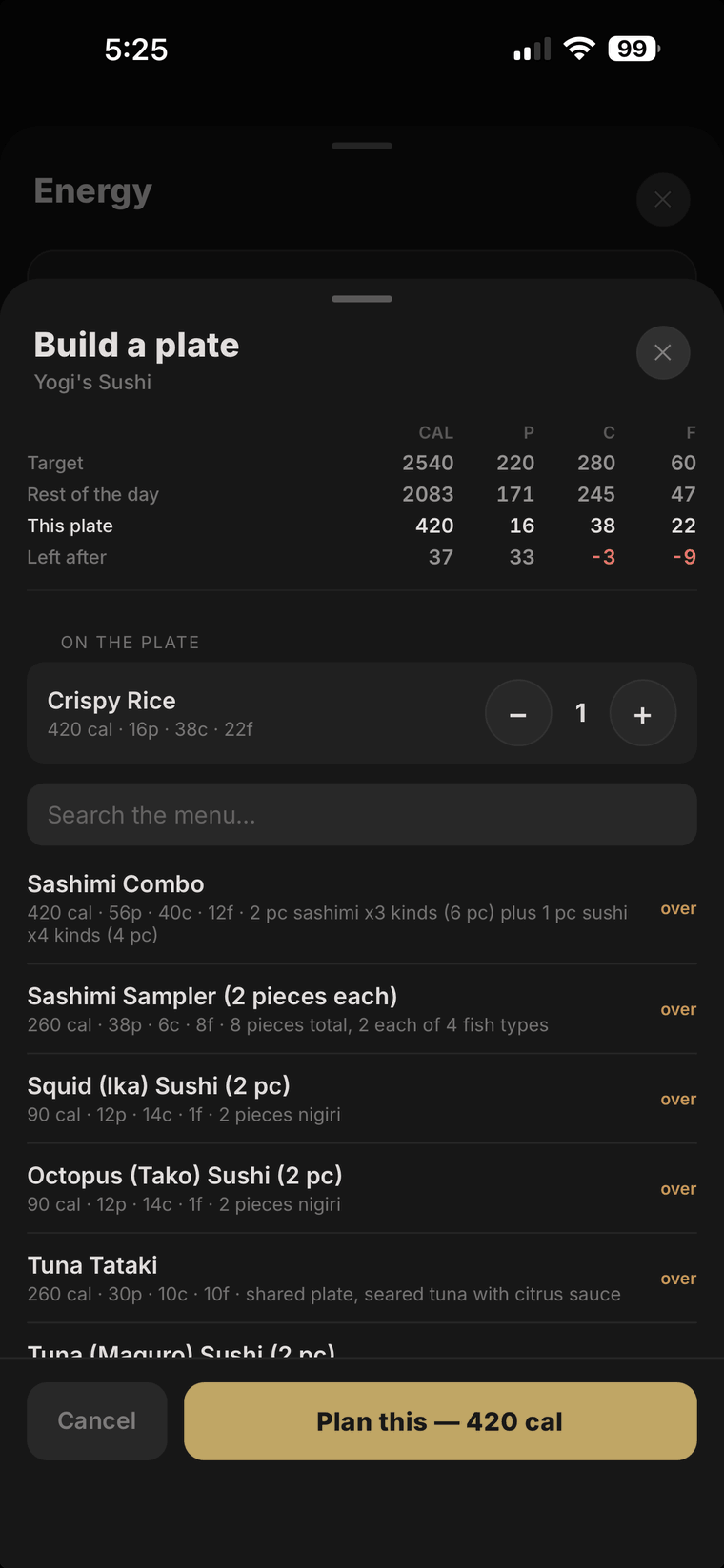
Or build the plate yourself. Browse the whole menu with macros worked out on every item, and compose the order yourself — the day's remaining macros counting down as you add each course.
Decide in the restaurant. The same menu and the same remaining macros, in your hand, one-handed.
Photograph the plate. The menu text, the restaurant tier, and how much of it you ate.
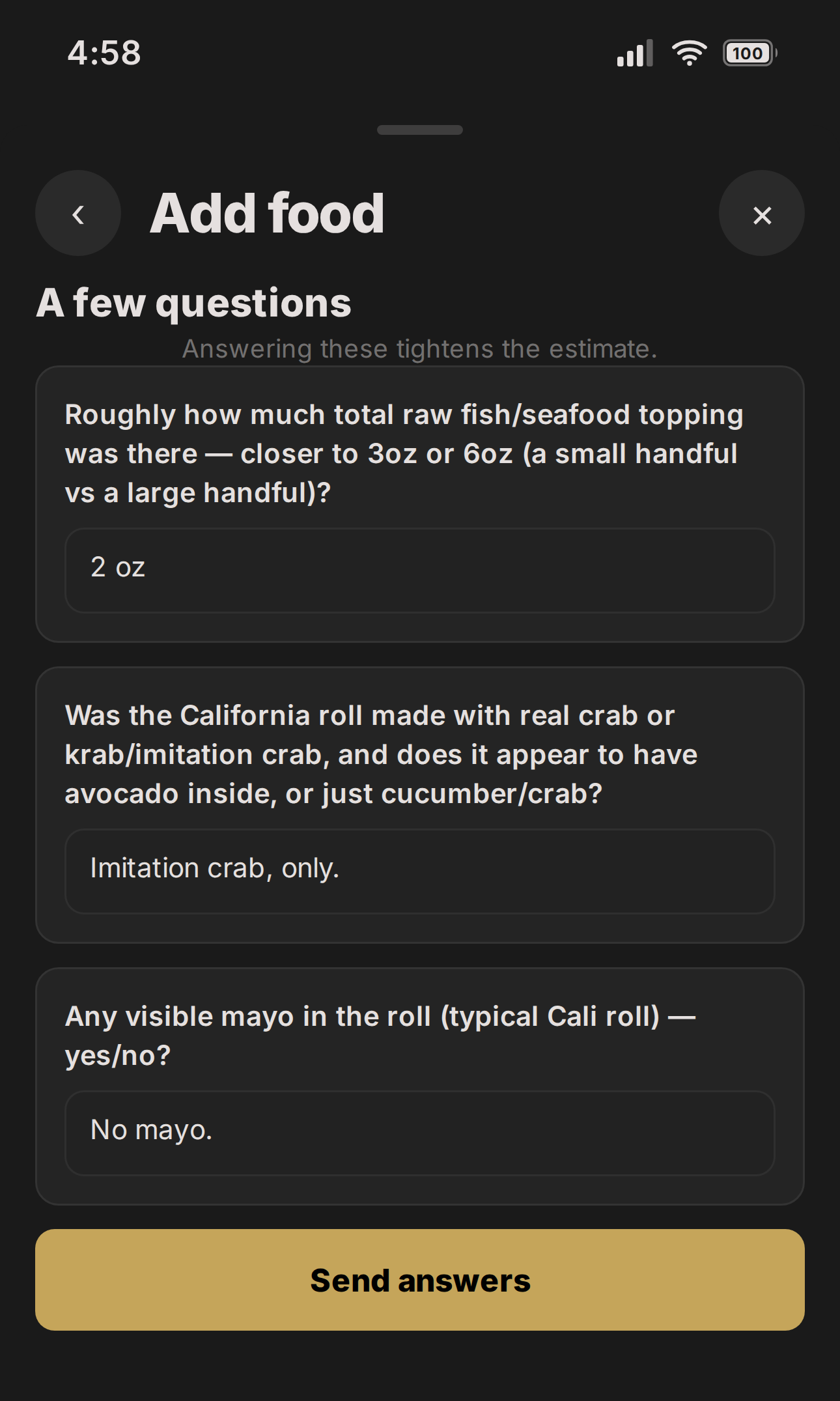
Answer what it asks. A few short questions, and only the ones that would move the number.
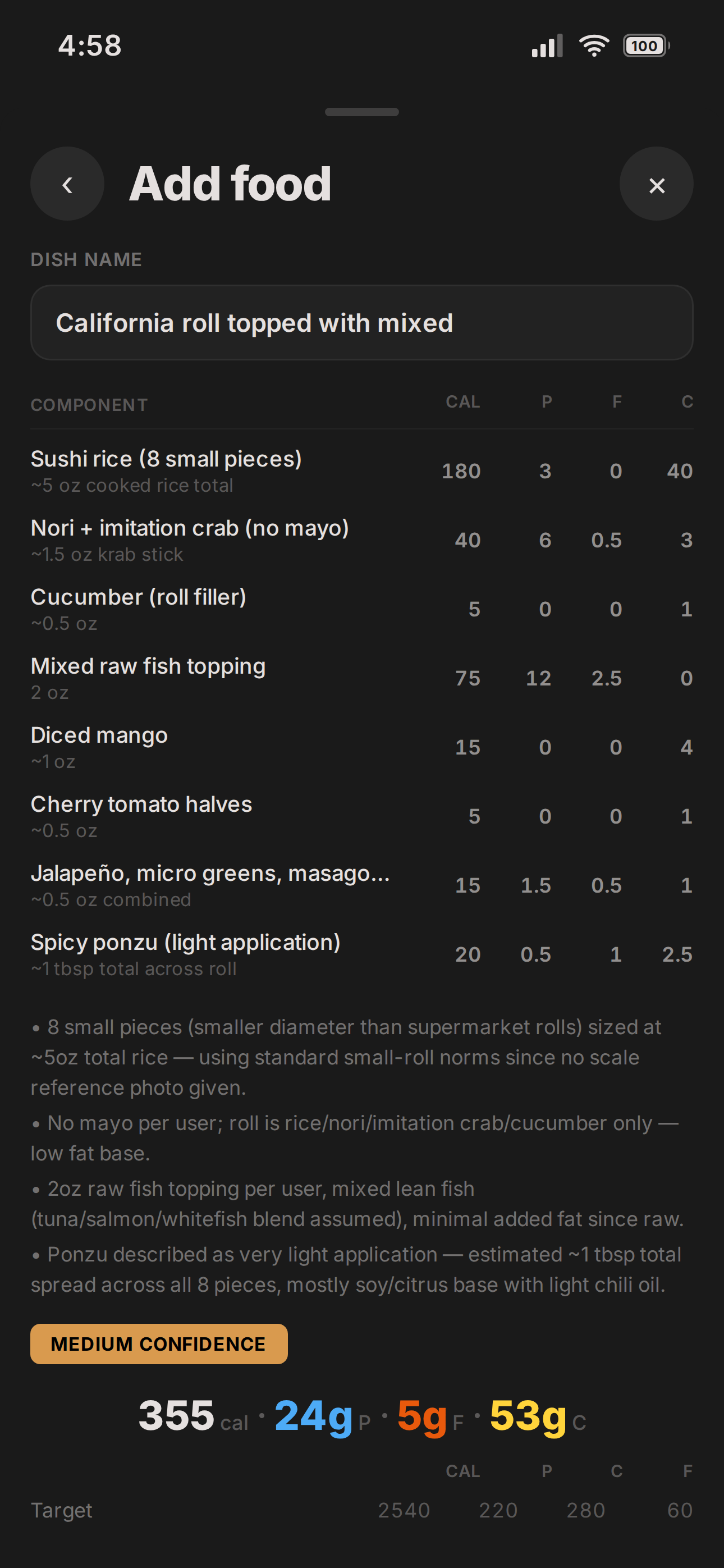
Get the numbers, then log them. Not one figure for the whole plate — a number for each thing on it, and one tap to put the meal in your day.
A measured dish does not only log your dinner — the measurement replaces that dish's estimate in the menu library, so the next order of it starts from something weighed rather than something guessed. That is the mechanism.
Get a restaurant's menu in once and it is read, its macros calculated, and kept — so you never work out the same menu twice.
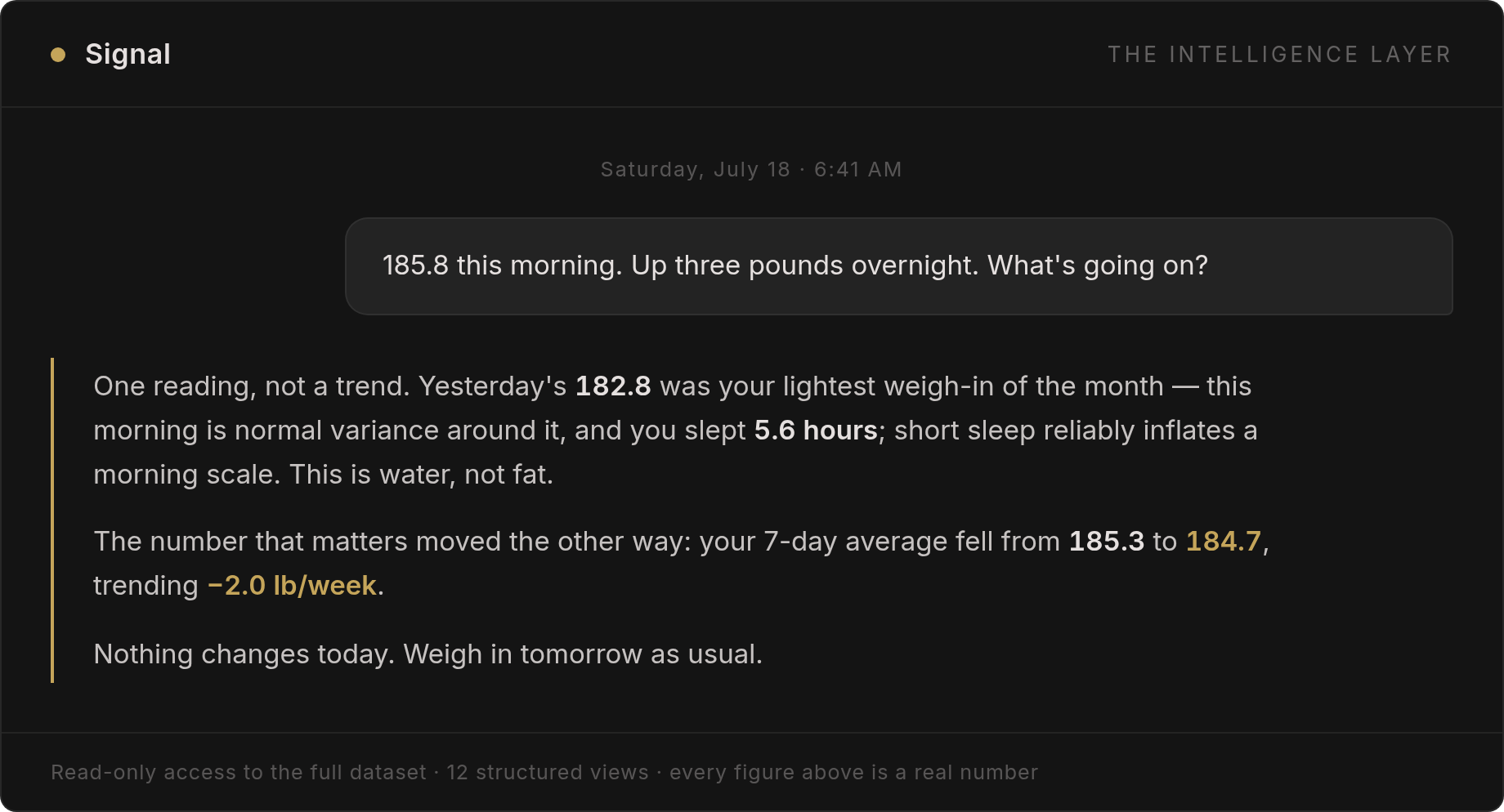
An AI layer with structured, read-only access to your entire dataset — twelve purpose-built views, every one returning real numbers. It reasons with discipline: excuses travel days from adherence, respects scale noise, refuses to call a trend on too few weigh-ins.
I'm James Miller. I spent the first decade of my career writing code, and the twelve years since as a solutions consultant in enterprise fintech — building and integrating systems for banks and credit unions.
I built this because I was exporting spreadsheets out of four apps and pasting them into an AI chat so it would know what I actually weighed, ate and lifted. That's a stupid way to live, and I'm an engineer, so I fixed it.
I run my own training, food and bloodwork through it every day. It isn't a side project I'll lose interest in — it has to keep working for me first.
The platform is in founding beta: complete, working, and evolving weekly. Beta members get the full system now, a voice in what ships next, and a price that will never be this low again.
Cancel any time. Billed by Stripe — nothing is sold inside the app.
With a six-month commitment — the honest minimum for a real recomposition. $29/month without one.
Founding members will be notified before any change, with time to decide. What a beta means: features evolve, things occasionally break, and your feedback steers the instrument. What doesn't change: your data is yours, and it's never sold or used for advertising.
The app measures, organizes, and educates. It does not provide medical advice, diagnosis, or treatment — see the Terms and Privacy Policy. Requires iPhone; Apple Watch optional but recommended.
One way of thinking underneath all three — measurement over motivation, evidence over enthusiasm. What changes is whose hands are on the instrument, and how much of the thinking is done for you.
Five founding seats. One man reading five men's numbers, every week. Five is the cap, not an opening number.
One operator on top of the instrument — the analysis, the planning, and the coordination between clinic, lab, and kitchen, done for you. The physique is the deliverable; the data is the receipt.
Request a founding seat →One cohort of 25, walked through a full four-month arc together. Enrollment closes September 7. Credited in full toward the Protocol.
Structured education on the medical levers reshaping performance medicine — the science, the evidence, and the questions worth bringing to your physician.
Explore the course →The founding rate holds while the beta does — founding members steer what ships next, and I would rather that be a hundred serious lifters than ten thousand tourists. This page.
The full instrument, self-run — you author the plan, the engine does the math, Signal watches the data.
Join the beta →Written to be answered honestly rather than persuasively. Where the answer is unflattering, it is still the answer.
Does any of this actually work?
The only long record on this platform is mine, and I publish all of it — twelve DEXA scans in ten months, every one published, including the ones that went the wrong way. There are no client before-and-afters on this site and there will not be. The beta is new. If you are looking for testimonials from men like you, they do not exist yet, and I would rather say so than manufacture them.
Is this a medical product?
No. It measures, organizes and educates. It does not diagnose, prescribe, interpret laboratory results, or provide medical advice — see the Terms and Privacy Policy. Every clinical decision stays between you and your clinician.
Does it connect to my doctor, my clinic or my lab?
No, and that is deliberate. There is no integration with any clinic, laboratory or telehealth service, and no commercial relationship with one either — no referral fee, no revenue share, no arrangement of any kind. What the platform does is organize your own record, so the appointment you were going to anyway starts from evidence rather than a vague complaint about being tired. You keep the doctor you already have.
What do I actually have to do every day?
Log what you eat, log what you lift, and step on the scale. That is the whole obligation. The engine does the arithmetic — energy balance against a full expenditure model, the next training prescription with its reasoning, travel logic, and the plate math on your wrist.
How is the app different from the advisory?
The same instrument, with different hands on it. The app is self-run: you author the plan, the engine does the math, Signal watches the data. The advisory is one operator reading five men's numbers every week and doing that thinking for them. The Protocol page covers the second.
What does “founding beta” mean, and what happens to the price?
It means the platform is complete and working, and also that features change weekly and things occasionally break. Founding members get the full system now and steer what ships next. The rate holds while the beta does; at beta's end it is $19.99/month with a six-month commitment, or $29 without one. Founding members are told before any change, with time to decide.
What do I need to run it?
An iPhone. An Apple Watch is optional, and makes the gym considerably better. During the beta, iOS access is through TestFlight.
What happens to my data?
It is yours. It is never sold, never used for advertising or marketing, and never shared with data brokers. If you ask for it to be deleted, personal data leaves active systems within 30 days and encrypted backups as those cycle — in no case more than six months — and you are told when each is done. The full commitments are in the Privacy Policy and the Consumer Health Data notice.